Wednesday, April 11, 2007

An Inconvenient Film?

When I saw the film An Inconvenient Truth, I had a double reaction. On one hand I thought it was a good film and was glad that people in positions of (some) power were speaking up about how humans are ruining the planet. On the other hand, I wished they hadn't made the film, because if you have to argue that global warming is real, that means that maybe it's not, because otherwise why do you need to argue it?

I thought of this again when I was looking on Facebook the other day for a group to join to show my support for solving the global climate change crisis. What I found, instead, was a plethora of groups arguing that global warming is a hoax. The biggest argument is "how can there be global warming if it's -10 F in the midwest, or snowing in the middle of April?!" I did a bit of research and discovered two things. 1) In spite of occasional cold snaps at odd times, average temperatures are still warmer. 2) This heat increases evaporation of water, which means more water in the atmosphere, which means more violent precipitation. (The article below explains it more). To counter the misconception that cold weather disproves global warming, I prefer to use the phrase "global climate change."

I doubt this film is the main reason people are moved to argue against global climate change. A more plausible reason is denial. People don't want global climate change to be real because it's frightening to think of deadly tropical storms, and cities swamped by rising sea levels. It's also possible that many people are using sarcasm as a way to broach the topic. One of the biggest Facebook groups I saw is called "Accelerate Global Warming!" and has a list of things we can do to increase global warming, but many of the responses written are actually about stopping global climate change.

Personally, I've never doubted global warming. It's been scientific fact my entire life, and I've seen it for myself as winters have gotten shorter and warmer, and summers more unbearably hot.

Labels: , ,

Friday, March 16, 2007

300 (That movie about warrior Spartans!)

I thoroughly enjoyed the movie 300. Yes, it was very bloody, and yes it looks rather like a comic book come to life, but I was warned about these possible short-comings, and took them in stride.

I loved the fearless spirit and incredible discipline of the 300 Spartan warriors who staunchly held their ground against all manner of attack by the massive invading Persian army, numbering in the tens of thousands. I didn't necessarily love the numerous decapatations and impalations, but it is a film about war, and I appreciated the artistry of the scenes ("a ballet of death" according to producer Deborah Snyder).

My only problem related to this film is the way it has been unjustly criticized by people reading too much into it. To me, it's just a film about fierce and noble warriors standing up to tyranny to defend their homes and families, but I have heard viewers and reviewers describe it as an allegory to the Iraq war, and as being rife with homoerotic themes--none of which even remotely occurred to me the entire time I was watching the film.

I could maybe understand the Iraq war allegory if the invading Persian army was identified with the Americans, but the people I have talked to, and the reviews I have read see the Spartan warriors as analagous to the Americans.

I am truly surprised that anyone would think this. In 300, the invaders are the Persians. They are tyrannical, they want to take over the world, and they are confident in their ability to do so. In the Iraq war, the invaders are the Americans. They want to control the world's economics (including oil), and they are confident that their way of life ("freedom", democracy) is the best. In 300, the Spartans are defending their homeland. In the Iraq war, it is the Iraqis who are trying to survive and protect their community from the tyranny of American control.

As far as homoeroticism, the primary source of this perception is the powerful Persian king's repeated attempts to have the Spartan king kneel before him. I understand how kneeling in front of someone can have sexual connatations, but anyone who's ever been an adolescent (or hung around with some of my college friends) knows that anything can have sexual connatations. In this film, kneeling is about submitting one's country; ("Earth and Water", as the Persian king's messenger says near the beginning of the film.)

Faulty interpretations aside, I have great respect for 300 as a film; as a dazzling piece of art about great people.

Labels:

Monday, December 18, 2006

Who killed the electric car?


Electric cars have been around as long as gasoline powered cars. One hundred years ago, there were more electric cars on the road than there were gasoline powered cars.

Electric cars make less pollution than gasoline powered cars, even if coal is burned to produce the electricity.

GM produced and leased fast, well-built electric cars (the EV1) over 5 years ago. Consumers loved them, and there was a waiting list of over 4000 people.

Through pressure from the car companies, the oil industry and the federal government, California repealed the clean air mandate that had led to these cars being made.

GM recalled and destroyed every one of their perfectly good EV1s, over the protests of the car owners, who would have loved to buy the cars. Other companies followed suit, recalling and destroying their electric vehicles.

The Bush administration is now pushing the hydrogen fuel cell, an expensive and dubious technology, while ignoring the fact that we already have the technology available to mass-market clean, safe, efficient electric cars.

Find out more

Read GM's rebuttal

Labels:

Sunday, December 17, 2006

Eragon


Eragon is a knock-off amalgamation of Star Wars, LOTR and other sci-fi/fantasy epics; it's mildly interesting because it's chock full of classic story ideas and characters, but the writing is second-rate. I was hoping the movie would be better than the book; that it would have been re-molded by the screenwriter and director into a more engaging package. It wasn't.

The film looks good: the costumes and armor are beautiful, and the make-up is stellar. The digital dragon works well enough not to be distracting, and the rest of the visual effects are fine. The filmmakers assembled an amazing group of actors; veterans (Jeremy Irons, John Malkovich) and newer faces alike, they all turn in amazing performances. (I would love to see Eragon and Arya in a different story.) But a film is a whole, and individual great performances don't count for much when they're not well-directed in a strong screenplay.

If you liked the novel, you will like the movie. I enjoyed the movie because I like the fantasy genre, and because I am a student of filmmaking and appreciated the numerous positive elements. If you're new to the world of Eragon, and are looking for great fantasy entertainment, watch Lord of the Rings.

Labels:

Thursday, November 30, 2006

Unknown White Male


Unknown White Male is a stylish documentary, based on the real life story of a young man who wakes up on a subway car in New York City with no memory of who he is, but otherwise completely functional.

This sort of total amnesia is rare, but not unheard of, and is the basis for such stories as The Bourne Identity. Unknown White Male was the first time I had read of (or watched) a real life account, so I was mildly enthralled. If you've already read detailed accounts of real people who have experienced total amnesia, you might not find this film as novel as I did, unless you happen to like edgy, indy British films.

The film starts with a narrated reenactment of "Unknown White Male"'s first few hours after "waking up." It then begins cutting in interviews with experts on memory and witnesses to his first few days. Not surprisingly, in our interconnected society, it doesn't take long for someone to recognize him, which launches the film into its most interesting phase: interviews with his family and former friends.

In this second half, the film becomes more than merely an interesting account, and begins to delve into philosophical questions of identity and socialization, which I enjoyed thinking about.

Watching the film, I found it interesting to theorize about possible causes of his amnesia, and even whether he could have faked it; both are issues that the filmmaker doesn't touch. I will leave it to you to discover whether the unknown white male ever remembered his past life.

Labels:

Friday, October 13, 2006

Thank you for smoking


This is not one of my usual movie reviews. I'm writing this review from the perspective of my job at a public library (although this is not an official library document, nor does it necesarily reflect the values of the library). The head of the AV deparment asked me to preview it, to see if it might be appropriate for our collection in spite of it's R rating (for language and some sexual content).

Thank you for smoking is a very sarcastic film. Being, as I am, not always great at understanding sarcasm, I'm not entirely sure what the point of the film is. But I think it is a commentary on the ridiculous lengths to which tobacco companies go to keep people smoking, even though everyone knows that smoking is bad for you.

A movie with this goal is admirable, but I'm not sure that it would find much audience at this library. It seems to be aimed at overly-educated, politically liberal people; the same people who drive hybrid cars and eat vegetarian food. I haven't done any studies, but I think that a large percentage of our patrons are Amish (who quit school at age 16), or otherwise reasonably conservative Christian people, and I have never seen a Prius in the parking lot. If they watch films at all, they are likely to choose Little House of the Prairie, or VeggieTales. Some patrons do check out popular documentaries like Supersize Me and Bowling for Columbine, but, come to think of it, I requested both of those for the library.

One thing I was supposed to pay close attention to was the language in the film. Is it really so bad? Yes and no. On one hand, there aren't people cursing up a violent storm. Instead, there are a number of characters who casually pepper their everyday speech with the f-word. Not as shocking, but perhaps a surer sign of a lost soul, and definitely not a great role-model for good Christian children (or adults).

Returning to the theme of sarcasm, if the movie is intended as a tongue-in-cheek story, then it is appropriate that the characters show their moral degradation through foul language. The question is, will our patrons see it that way, or will they just be offended? Considering the care we generally take to avoid offending our patrons, I think this is one film our collection can do without.

Labels:

Friday, August 25, 2006

She's the Man


She's the Man can come across as a typical teen popcorn flick, but bubbling just below the surface is an uncanny depth of insight into human relationships and sexuality.

The film is based on a Shakespearean play (Twelfth Night). It has the characteristic tongue-in-cheek flair of a Shakespearean comedy as well as the depth that makes Shakespeare classic, but She's the Man doesn't use any Shakespearean dialogue, and is set in a modern college setting. The movie uses the strong plot and characters of a Shakespearean play and produces an equally complex and entertaining modern Hollywood film. I laughed out loud many times, not just in a "this is funny" way, but also because, as Shakespeare could do so well, the filmmakers nailed the complexity of human interaction and sexual identity.

(BTW, in case you don't know the story, it involves a girl (Viola) pretending to be her twin brother, and then numerous people falling in love with others, most of whom are actually someone else, or a different gender.)

One of the strongest aspects of the the movie is the way Viola thoroughly adopts the mannerisms of a man, without letting us forget that she is, in fact, a woman. I watched this movie over the course of two days, and when I couldn't sleep for a while at night, I kept running scenes over in my head, trying to decide if I believed Viola both as an attractive woman, and a desirable man. I kept waffling back and forth between thinking "she's more a woman" and "she's more like a man" before I realized that I'd just answered my question!

I usually watch dramas and action movies because modern comedy films are silly and vulgar fluff. She's the Man combines a classic story with the best of Hollywood filmmaking to produce an intelligent, insightful comedy that adults and teens can not only enjoy, but also appreciate.

Labels:

Friday, August 04, 2006

Domino


Domino is a so-so action movie, something like a cross between The Italian Job and The Fast and the Furious, but without the humor, or the cars. It stars Keira Knightley, who spends a lot of time posing and pouting sexily. This doesn't make me like her character, but it does seem like an accurate way to play someone who is a violent tomboy and who used to be a fashion model.

Domino Harvey is a sulky, impetuous, and parentally neglected girl who eventually discovers her destiny as a bounty hunter (which, I was surprised to discover, is an actual profession). The writers made a great decision in choosing a major turning point in Domino's life as the focus of the movie, but that is the end of the good screenwriting. The movie starts near the end, not in a clever way, but simply as a ploy to try to make a more engaging movie. The only reason it works is because you have to think to figure out what is happening in a movie that otherwise doesn't require any thinking.

Domino tries to be existentialist and philosphical with the repeated phrase "Heads you live, tails you die," and ends with moderately poignant discussion of destiny, and a shot of the real Domino Harvey, whose life the movie is based on...Sort of.

My main complaint about this film is the sensational, achronological beginning. The movie starts with a violent and gory raid on a dingy trailer, leading the viewers to believe that the characters are violent criminals. In fact, the three main characters are well-rounded and, one might say, even professional. They do things a little on the gray side of the law, but not exactly the black side, and they are certainly not sadistic.

I was looking for a relatively mindless movie to watch last night, and this movie delivered. I would have been happier watching something else, but it was at least entertaining enough for me to stick with it till the end.

Labels:

Thursday, July 20, 2006

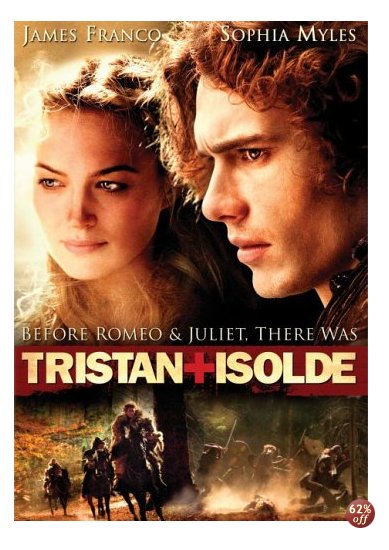
Tristan & Isolde (2006)


The legend of Tristan and Isolde is apparently even older than the legend of King Arthur. With all this time to work the kinks out of the story, and all the variations to read when one is adapting the story for the screen, perhaps I shouldn't be surprised that the story is the strongest part of the movie Tristan & Isolde. The rest of the film is solid, but has some distracing technical elements. Nevertheless, I eagerly looked forward to see how the story would end.

The story and screenplay are definitely the strongest elements of this movie. The plot is historically viable, and has no gaping holes. The characters are well-rounded and realistically motivated. There are no "good guys" and "bad guys"; everyone acts in a way consistent with their life circumstances, motivated by their fears and loves, and aided (or hindered) by their talents (or lack thereof).

I never thought twice about the costume design of the film, which means it was doing its job. The lighting, while taking the usual liberties during night scenes, was equally transparent. More obtrusive was the editing; there were some rough transitions back and forth between takes, and some slightly goofy stuff in which people and elements faded in and out of a static shot to show the passage of time. The movie does a good job of explaining who is who and where the action is taking place. I appreciated that near the beginning the filmmakers weren't afraid to put lots of text, and even maps, on screen to explain the history of the conflict and the locations.

I may have already attributed the "best casting of a character played by two different actors" in one of my earliest movie reviews, but the casting of the young and older Tristan is also among the best I've seen. What impressed me as much as the similarity between them was the sheer talent of the child actor. I've never seen children engage in fight sequences; the young Tristan did, and I knew instantly that his character was going to be an amazing warrior (which, indeed, he turns out to be). His ability to convey fear, anger, and confusion was equally impressive.

Before watching the film, I was afraid that I wouldn't be able to take James DeFranco (Tristan) seriously in a medieval setting (he plays Peter's friend Harry in Spider-Man). I almost couldn't, but he did an excellent job none-the-less. Sophia Myles as Isolde was sublime (in beauty and acting), but the real acting award would go to Rufus Sewell, as Tristan's lord and adopted father. What could have been a generic "king" role has more depth of personality than the main characters in some movies I can think of.

Tristan & Isolde is an excellent love story, and a strong medieval-setting film. It should appeal to anyone who likes films in either of these genres.

Labels:

Monday, July 10, 2006

Pirates of the Caribbean: Dead Man's Chest


Dead Man's Chest may be the movie Disney was intending to make when they made the first Pirates. You know, the movie that everyone thought would be a flop because it was based on a cheesy theme park ride, of all things!

The thing that annoyed me most about the movie was that it seemed to pander to 6-year-olds with cheesy thrills (Wow look, a big sea monster! Cool!!!!) and detailed exposition on any plot points that might not be completely obvious.

There are some interesting characters, old and new, many of whom we will likely meet in installment three next summer, but the movie was too busy trying to thrill us to spend time on anything with much depth (ha ha--no pun intended). The upshot of this was two-fold. On one hand I didn't buy that all the characters were praising Captain Jack at the end of the movie. I hadn't seen him do anything for anyone but himself during the entire story. On the other hand, I'm really curious to see what happens to a certain former Commodore, who may or may not be making a come-back....

Labels:

Thursday, June 01, 2006

X-Men: The Last Stand (X-3)


I was really looking forward to this movie, but I was disappointed. The acting and special effects were great, and the story had a lot of potential, but the movie just wasn't put together in a gripping, exciting way.

The superhero characters I have enjoyed getting to know through X-Men 1 and 2 are still there, but instead of doing cool stuff, they just strut around, serving the script. I feel their passion, but not their motivation.

At the end of a huge tragic scene, some of the characters start crying. When this happened, I felt suddenly catapulted out of the mood of the movie; I was just watching the actors cry, and I felt nothing, because the movie had done such a terrible job of telling the story during that scene.

One of the things I like about X-Men 1 and 2 was that the movies and characters are so strongly grounded in reality. X-Men 3 is closer to its comic-book origins, and suffers because of it. The comic-book X-Men have fantastical histories; almost all of them have died and/or lost their mutant powers multiple times. For me, the strength of the first two movies is being able to identify with the characters, even while being awed by their powers. In this movie, reality is a distant memory, and the mutants' powers are little more than a special-effects freakshow.

Labels:

Friday, May 26, 2006

King Kong (1933) vs. King Kong (2005)


The 2005 remake of King Kong, and the 1933 original are both excellent movies; if you like one, you will like the other. They both have a fascinating story, a plethora of strong characters, even the same cheesy monster fights. Without detracting at all from the original film, the remake updates the cinematography and special effects to modern standards. This is not to say that modern standards are inherently better, merely that they allow the film to connect more easily with contemporary audiences.

It is fascinating to see virtually the same movie told from two different perspectives. Both could be called "Hollywood movies" (though not necessarily in the literal sense) but the culture of America in the 1920s has a distinctly different flavor than the globalization of 2005, and although both movies are set in the 20s, the differences are striking. Obviously, the use of CG vs. stop-motion animation and color vs. black and white film, but even the way people talk, and the nuances of relationships are heavily influenced by their respective cultures. For example, in the 1920s, no apology was necessary for the implication that women (such as the heroine, Ann Darrow) were frail, and that men were their protectors. In 2005, the movie bends Ann's character ever so slightly to accommodate modern cultural views; she is still largely a pawn in the overall plot of the movie, but she is a more strong-willed and self-confident pawn.

I may be one of the few people who watched the 2005 remake of King Kong before watching the 1933 original. I don't recommend this, for two reasons: first, the remake builds on the original in a myriad of ways, paying homage to shots and actions, characters and even quoting specific lines. Watching the original, I found myself constantly back-comparing, thinking about the history of the movies, instead of moving ahead with the story. Second, it's easier to appreciate the enduring quality of the original, and the faithfulness and improvements of the remake when you watch them in that order.

Yesterday I bought the remake, and I'm looking forward to watching all the DVD extras!

Labels:

Tuesday, May 16, 2006

Spanglish


Spanglish is an insightful, passionate story about the relationships between a mother (Flor) and daughter, both immigrants from Mexico, and the family that hires Flor as their housekeeper.

In spite of numerous lines of dialog, and even whole scenes in Spanish, I never felt that the movie was straining to make us Anglos understand. The script was cleverly written so that there is always some sort of logical translation--usually a bilingual character translating for an English-speaking character. The sole exception is, unfortunately, in the climactic scene, where the film resorts to a rather mundane voiceover that detracts from the emotion of the scene.

My favorite scene is one in which the Hispanic daughter translates for her irate mother. Not only is the girl an amazing actress, imitating first her mother, then the man she's talking to, but I was shaking my head in amazement at the hilarity and poignancy of the situation; a daughter forced into the middle of a fight between adults, but dutifully translating, even when it hurts her.

Spanglish looks, at first glance, like a typical romantic comedy. It is in fact a realistic look at the complexity of interactions between and within two families, and across language and cultural barriers.

Labels:

Saturday, April 22, 2006

North Country


If I hadn't heard good things about North Country, I probably wouldn't have watched it; it doesn't seem like the kind of movie I would enjoy. But the movie sold itself to me by the intense human struggles it portrayed, and by the excellent quality of the acting that brought these struggles to life.

I never for a second thought of the people on screen as actors; they were their characters. Well okay, I thought of Sean Bean as an actor for about 2 seconds, but that's only because he's been in so many films I've seen lately. The main character is a miner, and a single mother--very different from me, yet I was completely able to understand her and sympathize with her.

I had read that this movie is about sexual harrassment. I guess it is, but that's a pretty vague phrase. I saw a movie about immature men doing cruel and disgusting things to women. I was appalled to realize that the real events that inspired this movie took place between 1984 and 1998. That is frighteningly close to the present.

I'm usually a fan of movies in which the main characters kick butt. North Country couldn't be more different, but far from being disappointed, I was inspired and awed. There were so many times when I felt the characters' inner rage, and knew they wanted nothing more than to spit in someone's face (or worse) for the evil lies being told about them. But I also felt their utter helplessness, because this is a movie set in the real world, and kicking your neighbor's butt won't really solve anything. Instead, again and again, characters showed incredible strength and did something constructive to solve their problems. The bravest thing I have ever seen any character do involved no violence or fear of death, just standing up and speaking out for justice.

North Country is an excellent eye-opener as to how far "civilized" American culture has to go, and it is a wonderful portrait of some incredibly courageous and hard-working people.

Labels:

Wednesday, April 19, 2006

King Kong

By implied request, here is a review of pure opinion. Enjoy!


I once defined loving someone as "wanting good things for that person." King Kong is a story of this kind of pure, unselfish love, and it is an excellent movie because of it. I don't want to spoil the story for you, but suffice it to say that I now add King Kong to the very short list of movies that made me cry.

King Kong is also one of the most thrilling action-packed movies I have ever seen. I saw it on my TV twice in a week and was totally carried away by it's intensity; I can only imagine how much more exciting it would have been on the big screen!

The only quibble I can possibly come up with concerning Kong is that it occasionally stretches reality just a little bit too much. There are times, while gap-jawed with awe about a scene, when I couldn't quite still the voice in the back of my mind (or on the couch beside me), saying, "Yeah right!" This didn't make the movie any less exciting and cool, it was just a bit distracting from time to time.

Labels:

Tuesday, April 11, 2006

National Treasure


Cool concept: There is a collection of treasure, acquired over thousands of years, that the Founding Fathers of America decided to hide.

Time-honored plot idea, well executed: A trail of clues, hidden throughout America, that lead to the location of the treasure.

Dubious physics: Pretty much anything involving fire or explosions made me wonder what sort of scientific logic, if any, was supposed to explain how X was causing Z....

Great actors: Nicholas Cage is probably near the top of many lists, some with the title "Great Actors" and some with the title "Weirdos." Personally, I think he may be a little of both. I happen to like him, and I think he does an excellent job in this movie. Diane Kruger may or may not be a good actress, but she has the advantage of being jaw-droppingly beautiful. Sean Bean (Lord of the Rings, The Island) also does an excellent job of acting, although his character is much less interesting.

Cookie-cutters (but yummy cookies!): Speaking of characters, National Treasure is filled with stereotypical ones. There's the hero, his side-kick and his girl, there's the bad guy, and the police guy, and the father, etc, etc. Same goes for the plot. It may be cool, but that doesn't mean it's original. However, this movie is so well made that I didn't care. I had fun watching it. Maybe I knew what would happen next, but I didn't care, because the characters had such an interesting way of getting there. Maybe a relationship was conventional, but then someone would say a funny line, and I would laugh and forgive them.

Labels:

Friday, April 07, 2006

A History of Violence


Average citizen Tom Stall attracts a lot of media attention when he foils a viscious attack on the employees of his small-town diner. He also attracts the attention of a some Philadelphia mobsters who seem to think he is someone else.

A History of Violence follows the popular trend of realism prevalent in many recent movies. This is not a "typical Hollywood movie" with cookie-cutter characters. The characters are real, and kept me guessing at where their interactions would lead them.

In spite of the good quality of the movie, neither my wife nor I particularly enjoyed it. However, I perceived the ending as more hopeful than my she did, an issue that the filmmakers admitted wasn't necessarily clear.

The main theme of A History of Violence is of course violence. Regardless of what you think of the characters and the story, this film will make you think about the place of violence in American culture, and about people's motivation for or against violent behavior.

Labels:

Wednesday, March 29, 2006

Kingdom of Heaven


The thing that sets Kingdom of Heaven apart from many other movies is that it successfully holds a number of different viewpoints at once. Kingdom of Heaven is set during one of the Crusades, and focuses on the military conquest and defense of the city of Jerusalem. But there are no "good guys" and "bad guys," nor is the war simply good or bad. At various times throughout the movie, war and violence are: a method of survival, a missionary effort, a way to protect innocents, a birthright, and a way to hold on to one's beliefs. This variety creates a thought-provoking richness to the movie, making it more than just another grand showcase of special-effects (though it is also that).

There are many excellent performances in this movie, including by Liam Neeson, as the main character's guide and father, and by Ghassan Massoud, as the Muslim general. Actor Orlando Bloom, a veteran of numerous big-budget war movies, does a superb job of portraying the main character Balian, a black-smith turned general. This character, a young man thrust into war with no experience, has a different way of looking at the conflict. For those who don't like war, this character is the key to enjoying this movie.

Labels: